
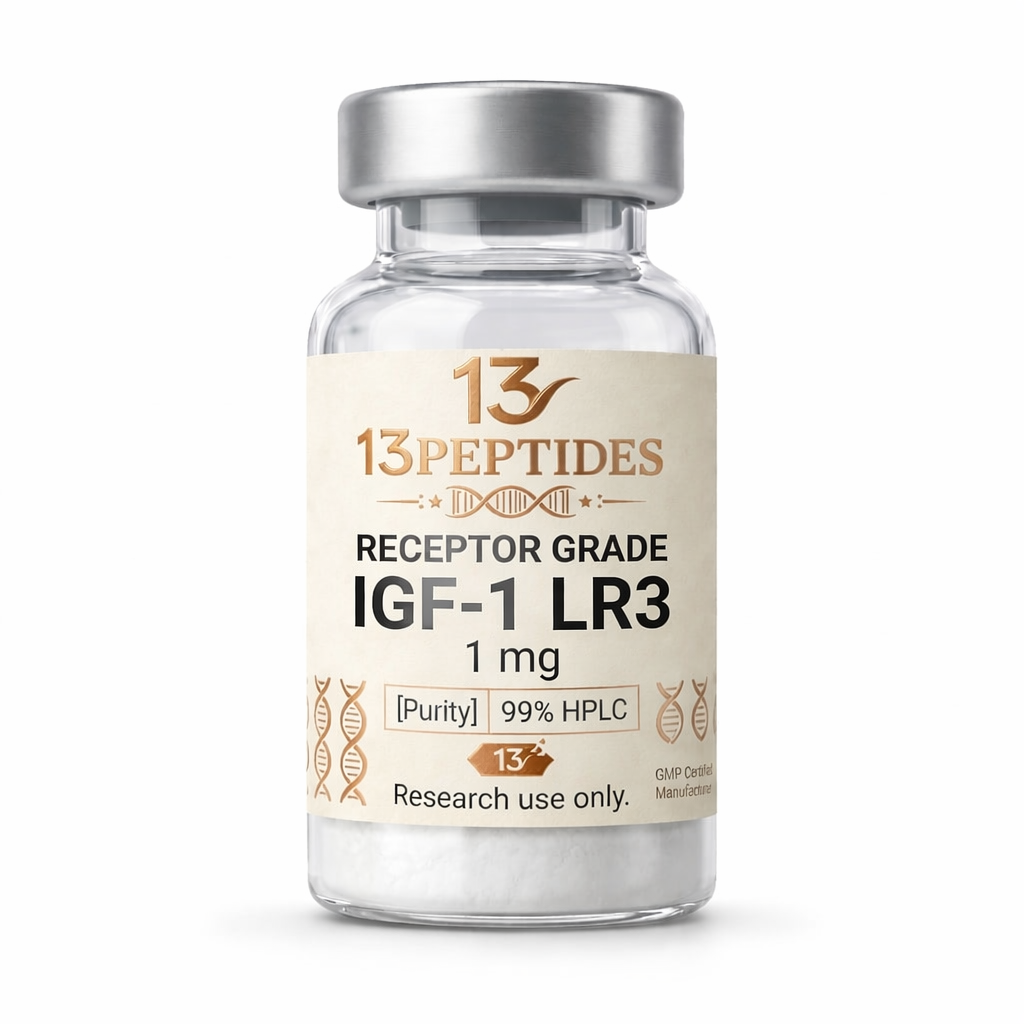
IGF 1 LR3 for Sale
Researchers seeking IGF 1 LR3 for sale often prioritize purity, consistency, and quality assurance. IGF-1 LR3 (Insulin-Like Growth Factor-1 Long Arg3) is a modified analogue of IGF-1 that has become a significant focus of scientific investigations involving cellular growth, tissue development, metabolic signaling, and protein synthesis pathways. Due to its extended activity profile and unique molecular structure, IGF-1 LR3 continues to be widely studied in laboratory settings. Our research-grade IGF-1 LR3 peptide is manufactured to stringent quality standards to support reliable and reproducible scientific research.
IGF for Sale
Researchers searching for IGF for sale products typically seek high-quality peptides suitable for advanced laboratory investigations. Purity and batch consistency remain essential considerations when selecting research materials.
IGF-1 LR3 for Sale
IGF-1 LR3 for sale products are commonly utilized in scientific studies examining cellular proliferation, growth factor signaling, tissue development, and metabolic regulation. Ongoing research continues to expand understanding of its biological mechanisms.
IGF LR3 for Sale
IGF LR3 for sale searches continue to grow as researchers investigate the peptide’s role in growth factor pathways and cellular communication processes. Reliable sourcing is critical for obtaining consistent research results.
IGF1 LR3 for Sale
Scientists interested in IGF1 LR3 for sale products often focus on quality-tested materials that provide dependable performance in controlled laboratory environments.
IGF 1 Buy
When searching for IGF 1 buy options, researchers should prioritize suppliers that maintain rigorous manufacturing protocols, third-party testing, and transparent quality control procedures.
IGF-1 Price
IGF-1 price considerations often vary depending on purity standards, manufacturing quality, testing procedures, and supplier reliability. Research-grade products should always meet strict quality specifications.
IGF1 Price
Researchers evaluating IGF1 price options should consider not only cost but also purity verification, batch consistency, and supplier reputation to ensure reliable experimental outcomes.
IGF-1 Buy
IGF-1 buy inquiries frequently come from researchers studying cellular growth mechanisms, tissue development, and metabolic signaling pathways. High-quality peptides help support accurate scientific investigations.
IGF 1 Peptide Buy
Scientists looking for IGF 1 peptide buy opportunities often require products manufactured under strict quality standards to support advanced laboratory research and reproducible findings.
IGF 1 LR3 Buy
IGF 1 LR3 buy searches are common among researchers investigating growth factor activity, cellular differentiation, and protein synthesis pathways. Research-grade materials help ensure dependable results.
IGF 1 Peptide for Sale
IGF 1 peptide for sale products remain in demand among laboratories conducting studies involving growth factor biology, cell signaling, and tissue development. Quality assurance is essential for successful research applications.
Product Specifications
- Product Name: IGF-1 LR3
- Purity: ≥99%
- Grade: Research Grade
- Form: Lyophilized Powder
- Molecular Structure: Long Arg3 IGF-1 Analogue
- Storage: Store in a cool, dry environment
- Intended Use: Laboratory Research Only
IGF-1 LR3 Research Applications
Researchers continue to investigate IGF-1 LR3 in studies involving:
- Cellular growth and proliferation
- Growth factor signaling pathways
- Tissue development research
- Protein synthesis mechanisms
- Metabolic regulation studies
- Cellular differentiation
- Regenerative biology research
- Molecular signaling investigations
Why Choose Our IGF-1 LR3
- Research-grade purity standards
- Third-party quality testing
- Strict manufacturing controls
- Consistent batch reliability
- Secure packaging
- Fast and dependable shipping
- Dedicated support for research professionals
Receptor Grade IGF-1 LR3 Peptide
Between 1940 and 1950, researchers identified and began studying the growth hormone somatotropin. Early investigations suggested that this hormone might increase sulfate uptake in rat serum, indicating a possible relationship with amino acid uptake and protein synthesis.
As research progressed, scientists isolated the factor responsible for this activity and named it “somatomedin.” Around the same time, separate investigations into insulin-like activity led researchers to identify compounds later known as insulin-like growth factors (IGFs).
Further studies focused on improving the bioavailability and biological activity of IGF proteins through structural modifications. One result of these efforts was the development of Receptor Grade IGF-1 LR3.
Receptor Grade IGF-1 LR3 is a modified analogue of IGF-1 that contains an additional arginine residue at position three and an extended N-terminal sequence consisting of 13 extra amino acids. This modification increases the total protein length to 83 amino acids, compared to the 70 amino acids found in naturally occurring IGF-1.
Also known as Long Arginine 3 IGF-1 or LR3-IGF-1, this synthetic peptide has been widely investigated for its potential interactions with cellular growth and development pathways.
What Is Receptor Grade IGF-1 LR3?
IGF-1 is a naturally occurring protein composed of 70 amino acids. Due to its structural similarity to insulin, researchers have long investigated its role in cellular growth, tissue development, and metabolic signaling.
Several synthetic variants have been developed to mimic or enhance the properties of endogenous IGF-1. Recombinant human IGF-1 (rhIGF-1) is one example, while IGF-1 LR3 represents a modified version designed to exhibit altered binding characteristics.
Researchers suggest that IGF-1 LR3 may demonstrate reduced affinity for IGF-binding proteins (IGFBPs). This characteristic may influence its bioavailability and tissue distribution compared with native IGF-1.
The designation “Receptor Grade” refers to a higher level of purity than Media Grade IGF-1 LR3, making it particularly suitable for advanced laboratory and cell culture applications.
Structurally, IGF-1 LR3 contains an extended N-terminal sequence and an arginine substitution at residue three, giving rise to the name “Long R3 IGF-1.”
Overview
Researchers propose that IGF proteins primarily exert their biological activity through interaction with IGF-1 receptors. However, scientific evidence suggests that IGF-binding proteins may also influence signaling through both receptor-dependent and receptor-independent mechanisms.
In one animal study, researchers compared endogenous IGF-1 with IGF-1 LR3 to investigate differences in tissue distribution and bioavailability.
The findings suggested that IGF-1 LR3 cleared from circulation more rapidly and distributed extensively into various tissues. Elevated concentrations were reportedly observed in organs such as the kidneys, ovaries, and adrenal glands.
Researchers theorized that these differences may result from the reduced binding affinity of IGF-1 LR3 for IGF-binding proteins, potentially altering how the peptide is transported and retained within tissues.
Scientific investigations further suggest that IGF-1 LR3 may participate in both autocrine and paracrine signaling pathways. These mechanisms allow cells to influence either themselves or neighboring cells through localized growth factor signaling.
The potential increase in bioavailability associated with IGF-1 LR3 continues to make it an important subject of research in studies involving cellular communication, tissue development, and molecular signaling pathways.
Chemical Makeup
Molecular Formula: C400H625N111O115S9
Molecular Weight: 9117.5 g/mol
Other Known Names: Long-(Arg3) Insulin-Like Growth Factor-I, LR3-IGF-1
Reviews
There are no reviews yet.